
The Harkat-ul-Jihad-al Islami, which has been maintaining a low-profile for some time, is planning a second terror attack on Ajmer, according to Intelligence Bureau sources.Intelligence Bureau sources told rediff.com that the HuJI, an offshoot of the dreaded Laskhar-e-Tayiba, plans to send across a double message through this operation. The police crackdown on the Bangladeshi immigrants following the Jaipur blasts has not gone down too well with the outfit.
HuJI leader Abu Zandal, who was recently arrested, said they had sent several consignments of grenades to Lashkar outfits operating in India until 2004, an unnamed security official was quoted as saying by the Prothom Alo daily. But the outfit failed to send the last such consignment as the Lashkar representative who was supposed to receive it was killed in an encounter with the Border Security Force near Bangladesh's Kaliganj frontier.
Bangladesh based Harkat-ul-Jihad-al-Islami, a militant outfit responsible for a series of terror attacks in the country and India was trying to mobilise foreign funds by setting up a charity to carry out subversive activities under its garb.
To divert part of the international attention away from it and project the increase in jihadi terrorism as a sub-continental and not a purely Pakistani phenomenon, the ISI is likely to accelerate this process of giving Al Qaeda-inspired International Islamic Front, of which all these organisationals are members, a sub-continental visage and clothing and project the so-called Kashmir issue as a root cause of this expanding phenomenon.
Bangladeshi officials said after questioning HuJI chief Mufty Hannan, they were 'almost sure' that the duo behind several terror attacks in the country had fled to India. The twins were arrested with explosives from New Delhi railway station in February 2006.
The SIT has secured important leads about the role of Harkat-ul-Jihad al Islami's south India chief Mohammed Abdul Shahid alias Bilal.
If we do not get out of our denial mode and act firmly against the extremist and anti-national elements, a 9/11 is waiting to happen in our homeland.
The IB says Al Qaeda suspects that the growing proximity between India and the US will prove fatal for its operations in Afghanistan and with its threat it hopes to slow down Indian designs of helping the US there.
Al Qaeda not only looks upon India as a close associate of the US similar to the UK, but also as providing favourable conditions for its overseas operations directed against US nationals and interests in Indian territory.
The ISI's new terror matrix comprises three major terrorist groups, at least half-a-dozen big and small front organisations with extremist ideology, spanning three countries.
The way the bomb blasts were triggered on May 13 in Jaipur and on August 25, 2007, in Hyderabad showed that the terrorists were trained at the same place, before being 'deputed' to the states by Harkat-ul-Jihad-e-Islami, the suspected organisation behind the blasts, according to police sources. A two-member special police team, which went to Jaipur to study the blasts, had came to a conclusion that there were many similarities between the two blasts.
Two kg of RDX and two detonators were recovered on Friday from Unnao, about 50 km from Lucknow, by Uttar Pradesh Special Task Force on the basis of information provided by a Harkat-ul-Jihad-al-Islami militant.

The National Investigation Agency filed a supplementary chargesheet before a special court in New Delhi on Monday against two terrorists of the Pakistan-based terror group LeT for their alleged involvement in a conspiracy to commit subversive activities and wage a war against India, besides killing key personalities of the Hindu community in the country, an official said.

An advisory issued by the American Embassy warned its citizens of an increased threat in places frequented by Westerners in the country.
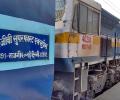
A Bangladeshi national, having links with Harkat-ul-Jihad al-Islami terror outfit, was on Wednesday awarded death sentence by a local court in Jaunpur, Uttar Pradesh for the 2005 Shramjeevi Express train blast which had killed 12 people and injured scores others.

Countries in the region like Afghanistan, Pakistan and Maldives face serious existential threats from a mix of terrorist groups active in the region and elsewhere

A total of 10 members of Hizbul Mujahideen, Lashkar-e-Tayiba and other proscribed outfits were on Tuesday designated as terrorists by the Union ministry of home affairs under the Unlawful Activities (Prevention) Act.

Two women were arrested and remanded to police custody for two weeks on Sunday in connection with the explosion at Khagragarh here that left two suspected militants dead.

Bangladesh on Wednesday executed banned Harkat-ul-Jihad al-Islami chief Mufti Abdul Hannan and his two associates for a 2004 attack on a shrine that killed three people and wounded the British high commissioner at the time.

Loopholes, lack of crucial evidence and lighter charges filed against those arrested in connection with the assassination of right-wing leaders are indicators of the NIA not being confident about its investigation. Vicky Nanjappa/Rediff.com reports.

A convict in the 1993 Mumbai serial bomb blasts case, Jalees Ansari, who went "missing" while on parole, was arrested on Friday from Kanpur in Uttar Pradesh, an official said. Ansari (68), a Mumbai resident who was serving a life term in a Rajasthan jail, was nabbed in a joint operation by Maharashtra's Anti-Terrorism Sqaud and the Uttar Pradesh Special Task Force (STF), he said.
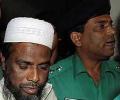
Eight Harkat-ul-Jihad al-Islami terrorists, including its chief, were sentenced to death by a Bangladeshi court on Monday for a 2001 bomb attack targeting Bengali new year celebrations that claimed 10 lives.
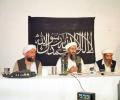
Al Qaeda's reclusive chief Ayman al-Zawahiri, who played a central role in the 9/11 terror attacks and later created the group's regional affiliate in the Indian subcontinent, was killed in a US drone strike in Afghanistan's Kabul, in the biggest blow to the global terror network since killing of its founder Osama bin Laden in 2011 in Pakistan.

A team of South Zone Task Force on Thursday nabbed Mohammed Nasir of Bangladeshi origin (who had migrated to Pakistan) on charge of having close links with HuJI and helping a IM operative, an accused in the 2013 Dilsukhnagar twin blast.

Azad asked why none of the ministers have issued a single statement of apology or the protest?

The arrest of Indian Mujahideen operative Abdul Sattar is proving to be a boon for the National Investigation Agency which has found that a Students Islamic Movement of India activist based in Dubai had acted as a key middle man in the setting up of the IM.
The outlawed terror group Indian Mujahideen is more lethal and resilient because of the support it receives from Pakistan, according to a new report by an American think-tank.

The CIA released 4,70,000 additional files seized in May 2011 when US Navy SEALs burst into the Abbottabad compound and shot dead Laden.
If viewed as a part of the Al Qaeda's radicalisation effort to produce jihadists out of discontented Muslim youth in India, the call could well have a much larger dimension, both in the near as well as long term, directly impacting on national security, says Bibhu Prasad Routray.

Intelligence agencies draw a list of terror outfits that pose the gravest threat to India. Vicky Nanjappa reports
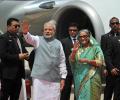
'When we have a terrorist outfit in a neighbouring nation, we need to do whatever we can to neutralise that threat,' says Ramananda Sengupta.

Sheikh Hasina's government has launched a relentless war against terrorism since the Dhaka cafe carnage in July 2016, but as Bangladesh's terror networks exploit new technologies and new tactics, the challenge to eliminate jihad gets tougher, points out Binodkumar Singh.

How to deal with a country that has made export of terror a reason to make the world notice and fund it? Rediff.com contributor Sanjeev Nayyar offers a few suggestions

Indian intelligence agencies have often claimed that left-wing extremists are trying to make inroads in the militancy-hit regions of north-east to foment further unrest. But Jaideep Saikia, noted terrorism and conflict analyst, claims, "People who speak of Maoism taking roots in the north-east have not read history".
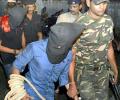
'Counter terrorism does not appear to be good guys fighting the bad ones; it is about people being picked up, detained and charged with crimes they did not commit.'
